Sweet Unicorn Coloring Pages for Kids
A Designer’s First Glance: Whimsy with Purpose
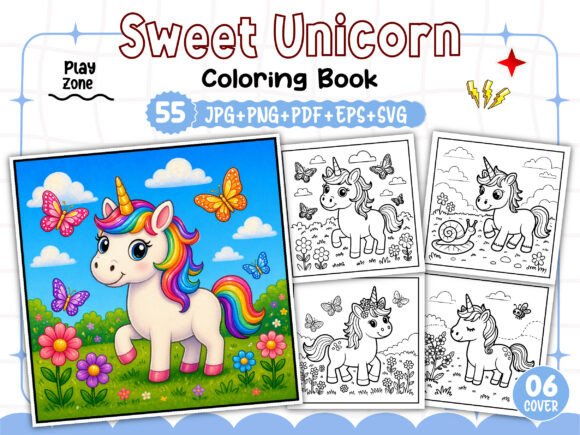
When I opened Sweet Unicorn Coloring Pages for Kids, my first thought wasn’t “cute”—it was “workable.” As someone who turns coloring-page graphics into machine embroidery designs weekly, I look past the sparkle and straight to line weight, negative space, and contour clarity. These six PNGs deliver clean, confident outlines—no pixelated edges or unintended gaps. The unicorns are friendly but not overly simplified; they hold shape at 3–4 inches wide, which is ideal for a tote bag design or baby embroidery on a onesie front. There’s gentle variation in horn swirls, mane flow, and tail curves—not cookie-cutter repetition. That matters when you’re building a cohesive boutique collection or designing printable mockups for Etsy listings.
From Screen to Stitch: Real Embroidery Behavior
I tested one unicorn layout on a medium-weight cotton twill tote—standard stabilizer, 40-weight polyester thread. What stood out? The design breathes. Unlike dense fill-stitch motifs that flatten under stitching, Sweet Unicorn Coloring Pages for Kids translates beautifully to satin stitch borders and light fill areas. It doesn’t demand heavy digitizing gymnastics. That means less time adjusting stitch density, fewer dropped needles on tight corners, and smoother results on curved surfaces like caps or pillow covers.
For sweatshirt embroidery, I scaled it to 3.5 inches and added a subtle running stitch outline—just enough definition without overwhelming the fabric texture. On baby embroidery projects (think organic cotton burp cloths or muslin swaddle tags), the open shapes kept stitching soft and safe against delicate skin. And yes—it held up cleanly on a tea towel mockup, even with the slight nap of woven cotton. No ghosting, no skipped stitches.
Where It Shines—and Where to Pause
Sweet Unicorn Coloring Pages for Kids excels in personalized gifts and small shop products where charm and clarity go hand-in-hand: embroidered patches for kids’ backpacks, nursery decor pillows, holiday embroidery on knit stockings, or custom aprons for a children’s cooking class. Its balanced proportions make it equally effective on light and dark fabric backgrounds—especially when paired with thoughtful thread colors (a warm rose for manes, deep navy for horns). Customers respond well to that handmade presentation: it feels intentional, not generic.
That said—proceed with care on stretchy fabric like jersey or thin knits. Without proper stabilizer, those smooth outer contours can distort. Tiny lettering isn’t included, so don’t expect built-in names or dates; this is a graphics set, not a ready-to-embroider file. Also avoid cramming it into hoops smaller than 4x4 inches—the finer mane details soften below that scale. And while it reads well on dark fabric, test contrast early: a light gray thread on charcoal may vanish unless you add an underlay or switch to white.
Practical Notes Every Embroidery Designer Should Keep Handy
- Always test on scrap fabric first—especially if using textured or layered garments (like quilted jackets or reversible totes).
- Review stitch density in your embroidery software before sending to machine. These outlines invite light fills, not heavy coverage.
- Confirm hoop size compatibility. At full scale, most unicorns fit comfortably in a 5x7 hoop—but check before digitizing.
- Inspect small details at 200% zoom: horn tips, eye highlights, and hoof curves should remain distinct after resizing.
- Test black-and-white mockups to assess value contrast—critical for digital product previews and craft fair signage.
- Use cutaway or tear-away stabilizer based on fabric weight; lightweight cottons need more support than denim or canvas.
- Verify licensing terms before selling finished products or bundling as part of a commercial embroidery project. This set is labeled for KDP interior use—but confirm reuse rights for physical embroidered goods.
Why It Fits Your Craft Business—Without Overpromising
This isn’t a plug-and-play embroidery file. It’s a high-resolution graphic asset—versatile, clean, and quietly professional. As an Etsy seller, I’ve used similar coloring-page-inspired motifs to build themed collections: unicorn + rainbow + cloud bundles for birthday embroidery kits, or seasonal variations (pastel for Easter, glitter accents for Christmas). Sweet Unicorn Coloring Pages for Kids gives me that foundation without locking me into rigid layouts or dated clipart styling.
It supports brand consistency because it’s neutral enough to pair with your own color palette, yet distinctive enough to stand alone. A customer ordering a custom embroidered sweatshirt won’t mistake it for mass-produced stock—they’ll feel the care in the line work, the intention behind the spacing, the quiet confidence of a design made *for* adaptation.
And that’s what makes it valuable: not as a shortcut, but as a thoughtful starting point. Whether you’re prepping for a craft fair, building digital embroidery files for sale, or stitching personalized gifts for local clients, these unicorns offer reliable structure—not just sweetness.
Final Thought: Design Judgment Over Decoration
There’s a quiet strength in Sweet Unicorn Coloring Pages for Kids—one that comes from restraint, not excess. It doesn’t shout. It invites. It leaves room for your thread choice, your fabric story, your customer’s name stitched just below the horn. That’s rare in today’s flood of digital embroidery assets. If you’re curating design assets for real-world embroidery projects—custom apparel, baby embroidery, holiday embroidery, or small shop merchandise—this set earns its place in your library. Just remember: it’s a graphic, not a file. Your skill, your judgment, and your attention to detail turn it into something truly handmade.