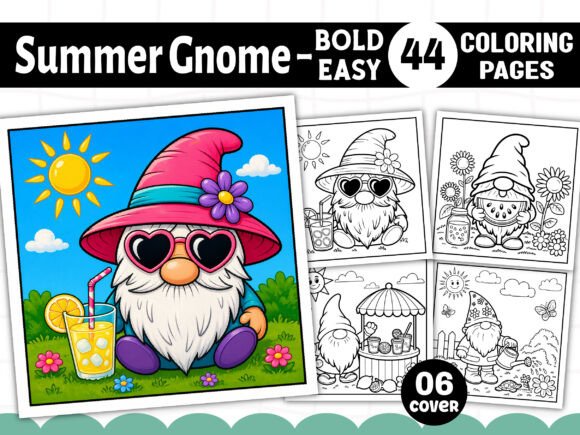
Summer Gnome Coloring Book for Adults
A Designer’s First Glance: Whimsy That Feels Hand-Drawn, Not Over-Rendered
Opening the Summer Gnome Coloring Book for Adults zip file, I immediately noticed what sets it apart from generic clipart-style coloring pages: a relaxed, confident line quality. These aren’t stiff vector outlines—they’re expressive, slightly uneven, with intentional weight shifts and breathing room around each gnome’s floppy hat or daisy crown. That matters deeply when translating to embroidery. A design with organic rhythm translates better into satin stitch flow and fill stitch texture than one built on rigid symmetry. For a custom embroidered tote bag destined for a local farmers’ market booth, this warmth reads as handmade—not digital. Customers don’t buy “gnomes”; they buy summer nostalgia, gentle humor, and the feeling that someone *drew* this just for them.
Where It Shines: Embroidery Projects With Personality
- Personalized gifts: The gnomes’ friendly, uncluttered faces hold up beautifully at 3–4 inches tall on baby onesies or tea towels—no tiny eyes or fussy details that vanish under stitching.
- Tote bags & aprons: Their vertical orientation and balanced negative space make them ideal for center-chest placement. No awkward cropping needed; the composition already feels intentional for flat, stable fabric surfaces.
- Patches & pillow covers: Clean outer contours mean clean cut edges after embroidery—critical for sew-on patches or quilted inserts where fraying undermines professionalism.
- Sweatshirt embroidery: Moderate detail level avoids excessive stitch density, reducing puckering risk on fleece-backed knits. The gnomes’ rounded shapes also follow fabric drape naturally, unlike angular motifs that fight stretch.
- Digital product previews: As Graphics, these pages convert cleanly to printable mockups—ideal for Etsy sellers showing how a finished embroidered pillow cover might look before stitching begins.
Where to Proceed Thoughtfully
The charm of Summer Gnome Coloring Book for Adults comes with real-world caveats—and skipping these steps risks disappointing results. On caps or curved hats, the gnomes’ wide-brimmed hats and layered accessories (think tiny watering cans or sunflowers) can distort if hooped too tightly or stitched without proper stabilizer support. On thin cotton tees or lightweight linen napkins, dense fill areas—like shaded grass beneath a gnome’s boots—may cause shadowing or stiffness unless you reduce stitch density manually or choose lighter fill patterns.
Dark fabrics demand attention: those delicate dotted borders or fine stem lines may disappear without high-contrast thread choices or subtle underlay. And while the designs are clearly intended for adult coloring, their simplicity makes them unexpectedly effective for nursery decor—just confirm licensing permits commercial use on baby items before listing embroidered crib mobiles or onesie sets.
What This Design Says to Your Customer—Before They Even Touch the Stitched Item
Embroidery isn’t just decoration—it’s a trust signal. When someone sees a well-executed gnome from the Summer Gnome Coloring Book for Adults on a handmade kitchen towel, they subconsciously register care: careful digitizing, thoughtful thread selection, respect for fabric behavior. That perception elevates perceived value. It tells them this isn’t mass-produced; it’s curated. For an Etsy seller bundling embroidered tea towels with matching oven mitts, that consistency builds brand recognition. For a craft fair vendor offering personalized sweatshirts, it creates instant visual cohesion across product lines—no jarring style clashes between your gnome tote and your floral cap.
But here’s the quiet truth: not all coloring pages translate. Some feel too sketchy for clean satin stitch definition; others drown in micro-detail that becomes muddy thread blobs. These gnomes walk the line perfectly—distinct enough to read at a glance, soft enough to feel inviting, and spacious enough to let fabric texture show through where appropriate.
Practical Notes Every Embroidery Designer Should Run Through
- Test on scrap fabric first—especially if using textured weaves like burlap or slub cotton. Those whimsical lines need to stay legible, not blur.
- Check thread color contrast on both light and dark backgrounds. What reads as cheerful yellow on white may vanish on navy unless you boost saturation or add outline stitches.
- Review stitch density in shaded areas. Heavy fills on lightweight fabric = stiff, uncomfortable wear. Adjust in your embroidery software if needed.
- Confirm hoop size compatibility. These designs scale well, but verify your machine handles the largest version comfortably before committing to a large tote bag layout.
- Inspect small details: dots, dashed stems, tiny flower centers. Can your machine reliably render them? If not, simplify or omit.
- Test black-and-white mockups—they reveal clarity issues color sometimes masks.
- Use proper stabilizer: medium-weight cutaway for knits, tear-away for stable wovens, and consider topping for napped fabrics like terrycloth.
- Verify licensing before selling finished embroidered items or reselling the digital files. The product description mentions KDP interior use—confirm whether commercial embroidery rights are included.
Final Thought: A Quietly Versatile Asset
The Summer Gnome Coloring Book for Adults isn’t flashy—but then, the best design assets rarely are. It’s a grounded, adaptable foundation. Whether you’re digitizing it for a boutique’s summer collection, turning it into an applique design for kids’ backpacks, or using it as reference for original hand-drawn embroidery patterns, its strength lies in restraint and readability. In a market flooded with overcomplicated graphics, this collection earns trust by doing one thing well: offering summer joy that stitches true.